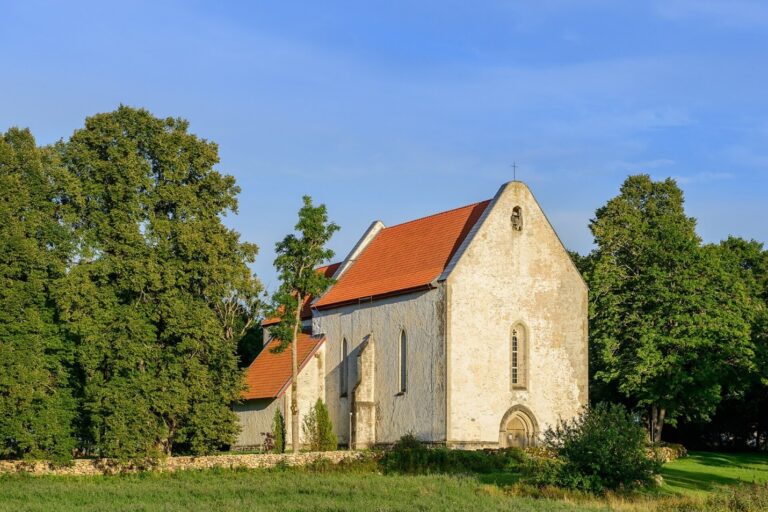
Karja Church seen from the north-west, with the west portal visible. Wikimedia Commons.
Karja Church is one of the oldest and most unique churches in Estonia. It is located in the parish that carries the same name. The church is nowadays dedicated to St. Catherine. Karja church contains several well-preserved medieval reliefs and paintings, and its exterior has remained archaic – without a tower attached to the church.
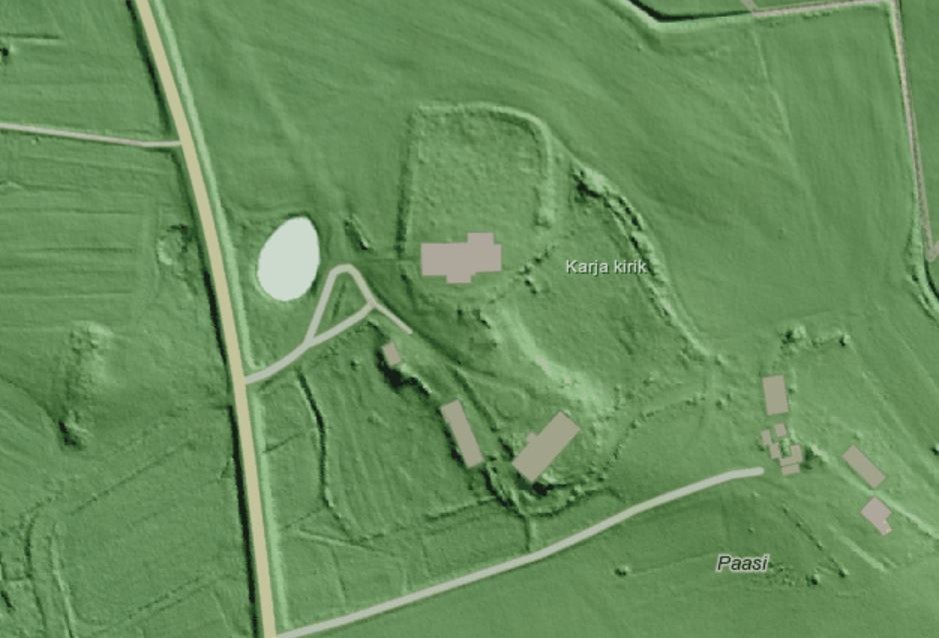
Karja Church and the surrounding landscape viewed from the air. Geoportal of the Land and Spatial Development Board.
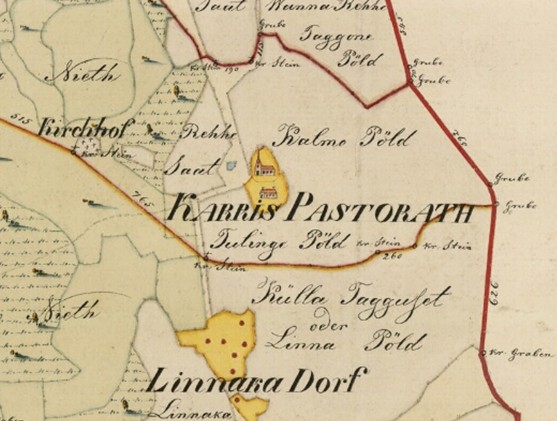
The church and parsonage are located on a plateau that is clearly higher than the surrounding landscape. The edges of the plateau are strikingly steep, measuring approximately 160 x 120 m. At the foot of the plateau is a small body of water, which has been there since the late 18th century and was probably there even earlier. To the north of the church is Kalmu (Burial) field, where there were probably stone graves. It is likely that some kind of sacred place was located on the site of the church earlier. This is also indicated by the field 150 m to the south, which is called Linna Põld (Town Field) on old maps. Further south is the village of Linnaka. Place names associated with Linnaka in Saaremaa usually refer to old gathering places, which were most likely connected to both the pagan sacred site and the church that was later built there.
Karja church on the map of 1831. (LVVA.6828.4.474 leht 1, fragment).
About two kilometers southwest of the church, lies Karja Manor, under whose barn and in the surrounding area the oldest Christian burials in the region have been found. In the 13th century, there may have been a private church or chapel belonging to a wealthy family who resided there. Until the beginning of the 14th century, small private churches were common, and there may have been more of them in the area. Karja Church, as the parish church, was the most important of these and still stands today.
In addition to Karja Manor (first mentioned in 1527), other oldest known manors in the area are also located nearby: Koikla (1399), Roobaka (1519), Aru (1519), and Ratla (1444). The ancient burial mounds surrounding them indicate that the local elite lived in the area where the later manors were built long before the adoption of Christianity.
Karja Church has retained a very archaic form, that of a fortified church. The building plan is that of a single-nave longitudinal building without a tower. In the northern part of the church there is a sacristy and an old fireplace above the vault. Both the fireplace and the strong walls of the church indicate that when the church was built, the possibility of using it as a place of refuge in times of danger was also taken into account. The reason for this may have been the ongoing military conflicts in Saaremaa in the 13th century. More specifically, the plundering of the Karja area by the Teutonic Order’s troops in 1345 is mentioned in descriptions of the St. George’s Night Uprising.
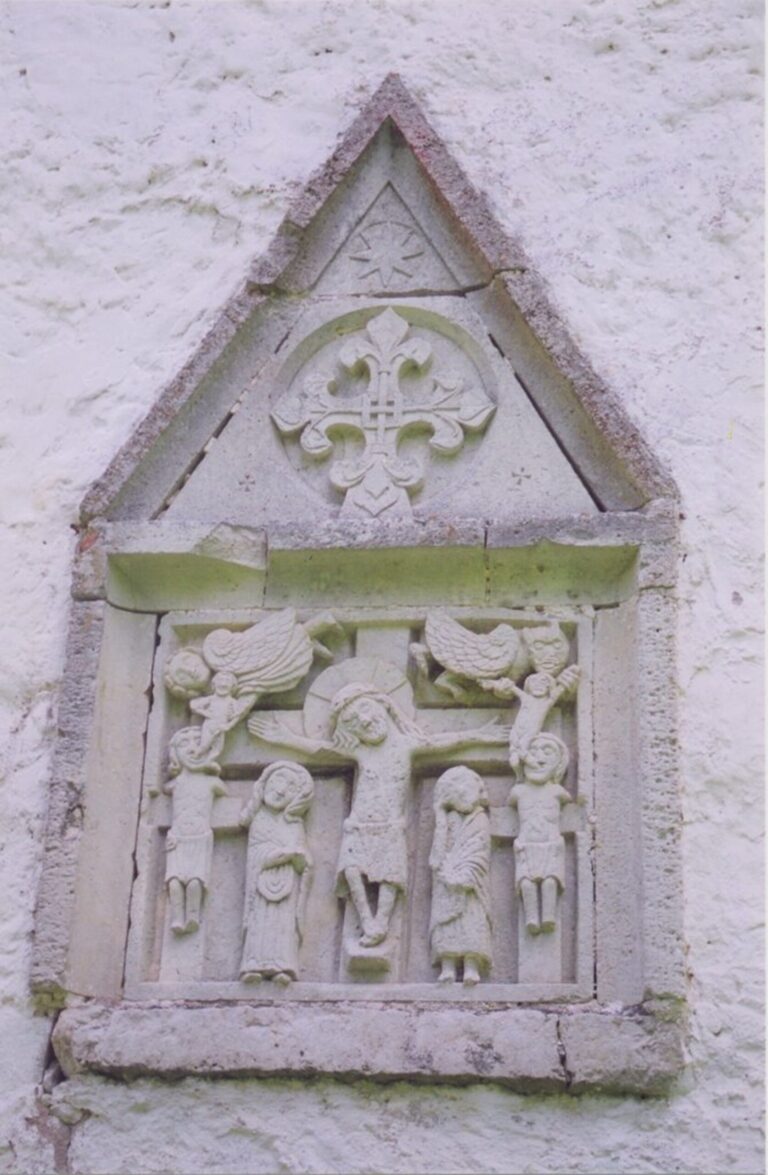
Calvary group. Wikimedia Commons.
Karja Church is known for its paintings, carved decorations, and sculpture groups, which give us clues about the social and cultural conditions in Saaremaa in the 13th–14th centuries. Various researchers have pointed to the influence of Westphalia and Gotland in this regard. The first message to visitors to the church was provided by the aforementioned Calvary relief above the south portal, which indicated that they were entering the kingdom of the Christian God and his son. The relief depicts the crucifixion of Christ, with the cross and the crucified Christ on the left and the Virgin Mary and the Apostle John on the right.
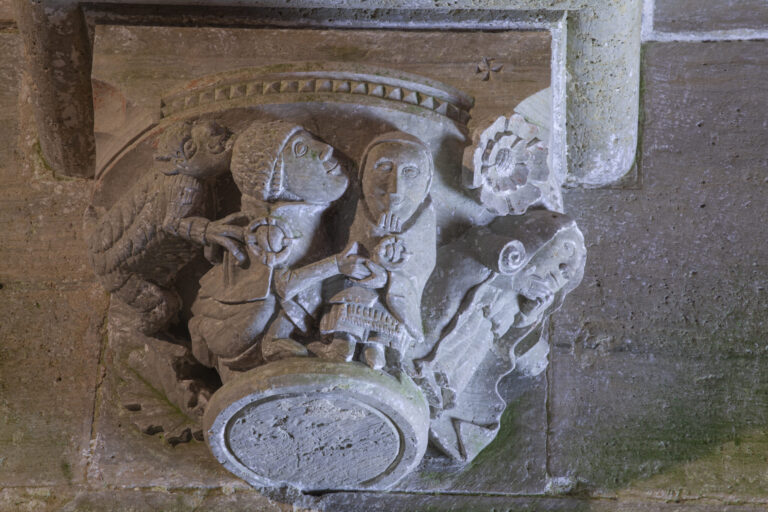
A sculpture group depicting the local woman and her seducer. Photo: Jaana Ratas.
When entering through the west portal, which is where most people enter the church today, two medieval islanders catch the eye. One of them depicts a wealthy island woman wearing an exceptionally large penannular brooch and an ornate apron. Her hair is covered with a headscarf, indicating that she is married. She is holding hands with and leaning against a man depicted in profile, who has the devil on his back. The purpose of the entire sculpture group may have been to explain the Christian understanding of marriage and the relationship between men and women.
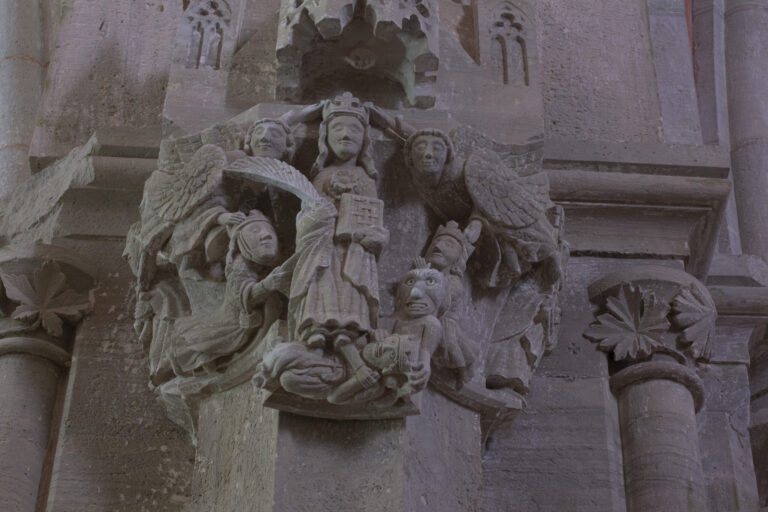
Sculpture group of Saint Catherine. Photo: Jaana Ratas.
Although Karja Church is now under the protection of St. Catherine, it is not actually known to whom it was originally dedicated. St. Catherine is depicted on the triumphal arch, but without her usual attributes, i.e., the wheel and sword. However, Peter and Paul are depicted alongside her.
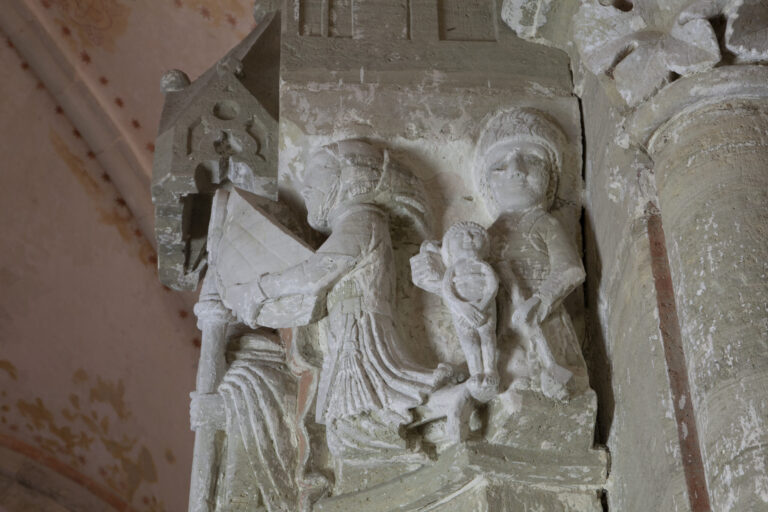
A man with a sword and a child depicted in the sculpture group of St. Nicholas. Photo: Jaana Ratas.
However, the triumphal arch also features a sculpture group of St. Nicholas. St. Nicholas was revered as the patron saint of sailors, among other things, and would have been a fitting saint for the church in Saaremaa. In addition, one side of the arch depicts a man with a war club holding a small child. Similar 13th-14th century war clubs have been found in Estonia and are believed to have been the symbol of military leaders. It is possible that the relief depicts a father and son, implying that the father is an important warrior. Both the man and the child wear similar headgear, probably some kind of fur hat, which has been considered characteristic of the local Estonians.
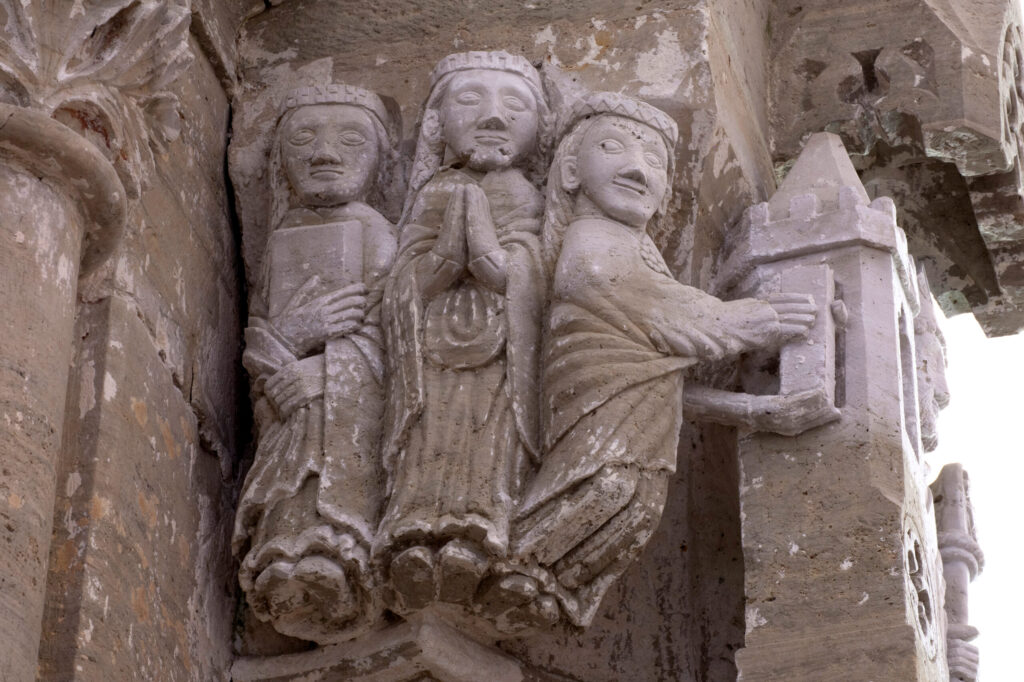
Three virgins in the sculpture group of St. Nicholas. Photo: Jaana Ratas.
On the other side, however, three virgins are depicted, to whom St. Nicholas gave dowry, thereby saving them from being sold into prostitution. This story has been immortalized in Karja Church with some local peculiarities. While dowries are usually symbolized by a bag or sometimes an apple, in Karja Church, Nicholas hands the girls something that looks like a flat box. Traces of what is likely a flat wooden box containing jewelry and metal-decorated clothing, and in one case a dagger, have also been found in some of the 13th-century female graves excavated near Valjala Church. It is not impossible that such boxes symbolized dowry in both funerals and church figures.
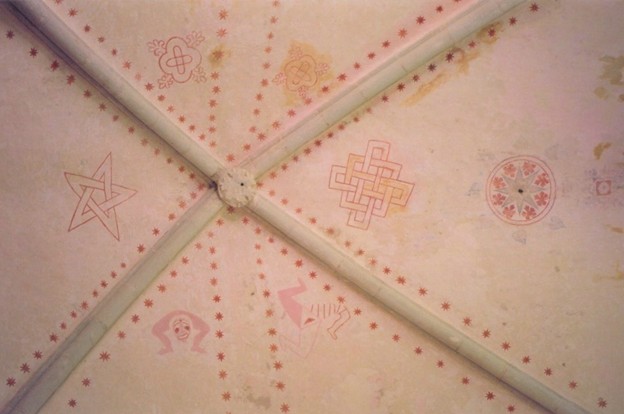
Ceiling paintings. Wikimedia Commons.
The ceiling of the choir room features eye-catching vault paintings surrounding the keystone, which have been considered pagan or ancient symbols of ownership, but which all carry meaning in the Christian system: intertwined squares, a tripod, a devil, a pentagram, and the Star of the Virgin Mary. Parallels can be found in the churches of Gotland, where so-called paradise vaults can be found. Based on the location of the paintings, it can be assumed that they were completed at the same time as the rest of the choir, i.e. probably in the first half of the 14th century.
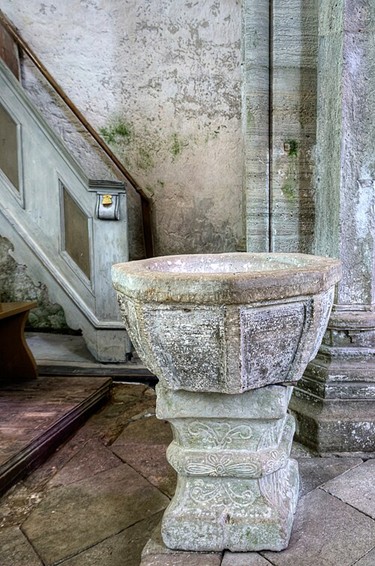
The baptismal stone of Karja Church. Wikimedia Commons.
The dating of Karja Church is based primarily on its baptismal stone. It is small in size and characteristic of the first half of the 14th century.